
«Cabiri, you who dwell in the earth's deep entrails
hoarding treasures or the sap that revives the fields,
archers of the heights who loose the thunderbolt,
spirits of the shadowed wood, of sea and mountains,
shades of our forefathers, terror of foreign peoples,
receive now the sacrifice, that it spread pleasing to you all!
«Drink, O Gods! The tribe that invites you to drink
pours upon the altar its richest libation…
If the hot blood of ox or ram pleases you,
human blood pleases you far more, of costlier life.
Your wrath is sated by it, and in that fullness forgets
offense and vengeance… From blood, forgiveness springs!»
So sang a hundred voices in chorus beneath the boughs
of the sacred oak; and with savage majesty
the chant spread wide through the wood and through the night.
Among the pinewood fires, a hundred youths at once,
forming a warrior dance, circled the great trunk
of the tree ancient in years and the great altar of stone.
Sun-browned, sturdy and agile, clad in smooth hide,
their bodies girded with slings of triple cord,
wearing helmets crested and plumed, where there ruled
the feather of the kite or of the sea eagle,
they bore gleaming new spears and new shields of bronze,
bought at the price of slaves from merchants of Hiram
bound for Tarshish.
Upward, toward the branches,
the sacred fire already raised its fateful flames
for the sacrifice, upon the altar of the talaiot.
Near the cyclopean altar stood the priest,
long of hair and beard, whose whiteness
outdid the wool of his ample robe,
crowned with dark-green foliage of oak.
Robust in his old age, of the venerated tree
he had the whole bearing, hieratic, impassive,
so as to master in solemn calm all that was horrible.
Eight priestly ministers served the great old man.
Gentle and pensive, before him sat,
upon a sheaf of sacred herbs, gathered by moonlight,
the great seer of the people, the maiden Nuredduna.
Her eyes radiated all around a divine dream…
A sprig of rosemary bound her brow,
and in curls her black hair overflowed,
flowing to shadow her sweet and austere face.
Her gown was gathered at the waist by a girdle
of barbaric richness, and a sharpened sickle
of silver, gleaming upon her robe, cast to the eye
glimmers of a serene, yet sorrowful half-moon.
Granddaughter of the old hierarch, she had had her cradle
within the sacred precinct, and as a child had already learned
from the ancient wise-women the whole art of sacrifice
and of healing herbs, of dreams and of auguries.
She guarded the hymns, and the traditions
of the people, and in new chants told them visions
in which a new light appeared for their hearts…
Flower of her race, she was its maiden poetry!
At the foot of the great trunk, bound, motionless, mute,
twelve captives stood in the sad postures
of victims yet to be. By their dress and bearing
they plainly showed the race of the fair Hellenic land.
They were Greeks from the windswept isles of the east
who, sailing toward the broad coast of Hesperia,
had put in near the fair beach
of Bòcchoris, a new colony of Boken-Rau,
from where, victorious, Egypt's law was given
to the tribes of Clumba, the greater Balearic isle.
It was that very tribe, not yet subdued,
that had seized them there in an ambush,
when they, sailing along the island's coast, at a headland's fair shelter
had come ashore as if in a friendly land,
leaving their strong company aboard the ship.
So they, now in the cruel wait for their agony,
eyes lowered, without complaint, as befits the brave,
turned toward their homeland a sad and gentle memory
and felt more strongly the longing for their hearth.
Among them was a gallant youth, in likeness
to the God son of Latona, the Archer with the golden lyre.
Melesigenes he was called, and being in the flower
of his years, he carried, alongside his weapons just then broken,
the lyre of the rhapsodes.
Over the silent strings
he would clench, from time to time, his strong and gentle hand.
Seeing this, one of those captives, older and more calm,
then made a sign to him, saying: “Melesigenes,
if you still hold the genius of the high muse,
why do you not now sing our mortal farewell?”
The rhapsode drew himself up, and, present all around him,
the enchanted notes of a prelude trembled forth.
In vain the riotous voices thundered out
from all that tribe, for from the talaiot
the maiden Prophetess, at the Priest's command,
made a sign for silence. All fell still, and pure
the voice of the noble rhapsode rang through the thicket.
«Farewell, homeland of heroes, land of harmony!
Farewell, hearth and parents, brothers, friends, kinsmen!
Farewell, living light of Helios, splendid king of the day,
lands where every race of speaking men is bred,
sea of countless murmurs, sweet air of the living!»
«Farewell!…
Over seas and lands, following vain courses,
here we came to meet our appointed end,
according to the dark weaving of those three sisters
who hum out destinies while spinning human lives,
the old Moirai, daughters of Erebus and Night.
“O Clumba! In you we did not believe we'd find so harsh a fate,
seeing how you rose from a sea and sky as blue
as those of our homeland, and in rock and greenery
you showed your form like one of the Cyclades,
ah! like holy Delos smiling on our ship.
“Your waves seemed to me the sirens' playground,
your fields like those of the island where divine Odysseus
in a nymphs' dwelling almost forgot his sorrows;
and already in your rugged, serene coasts I saw
the hidden palace of Thetis, the caves of Proteus.
“At Bòcchoris, the well-founded town of the Keptes,
I already dreamed of the new wall of a colony of ours…
But, alas! a far different fate was kept for us here
in the hands of this tribe, begotten of Cyclopes,
that dwells among heaps of rock deep within the dark wood.”
“And so, far from any hymns of victory,
today the cruellest Moira hurls us down
to the kingdom of shadows, leaving no memory…
If only there we could sing the ancient glory
of the dead heroes, who wander the field of Asphodel!”
So sang the poet. The tribe there, listening
without understanding, drank in the waves of that song,
like dry, harsh grass drinking fresh rain.
But, like the tender wild rose, that as a bud
suffered thirst, lamenting it in the heart of the dry summer,
at last, bathed in rain, bows its head and lives;
so too then did the maiden Nuredduna,
her most beautiful brow bowed beneath dark hair,
drink a new enchantment from the unrecognized song…
And fixing her gaze upon the noble figure of that captive,
compassionate and full of wonder,
she felt revealed the life of a splendid new world,
the rhapsode seeming to her like an immortal.
Suddenly the old hierarch made a sign,
and Nuredduna, rising, brandished the gleaming sickle.
Then the bloody immolation began.
A sinister horn sounded. Pairs of warriors
bound the prisoners hand and foot to the ground,
bearing them to the fatal place of sacrifice.
Already the old man spoke brief words with mystery, and their service
his ministers rendered, and already the first captive,
his blood given, was burning upon the sacred embers.
Then the prophetess, who with her woolen veil
would usually cover her head before human death,
uncovered herself, and at the highest edge of the talaiot,
with the resolute bearing of one who cannot keep silent,
raising to the sky her bare arms and the gaze
of eyes in which flashed the spell of one inspired,
thus spoke: “Hear me, ministers and warriors!
It is needful that this young singer of the strangers
not shed his blood here. As the chosen victim,
the Unknown God now wills that we deliver him alive
there within the great cave, his mysterious temple.
There, in days of anguish, a fearful people
enters to leave there its purest victim…
Let us leave this youth alive within the dark cavern—”
No sooner had the maiden finished than a sickly man,
deep-eyed, whose eyes gleamed amid grizzled hair
like embers glowing within ash and cinder,
said: “The prophetess is perhaps too tender-hearted,
and the God who has inspired her may well be compassion.
The tribes are not in a time to grant pardon,
today when strange peoples subdue the whole island,
today when only these free rocks remain
amid these mountains for our sacred fire.
O tribe of the Oak, wish not for pity!”
At the sound of such words, the great old man rose: “Who casts
suspicion on the sacred maiden, who has unveiled
the divine will? I wish that this captive
be kept alive, reserved for the God of the caverns…
There a more fearsome torment surely awaits him,
and so this sacrifice will be more acceptable.
Honor to the maiden, who is the flower of my blood!
Whoever speaks a word against her spits upon my white hair!”
A respectful silence reigned among the crowd,
and beneath the lofty old man of venerable bearing
the ministers and warriors bowed their heads.
While all around the eleven prisoners met their end,
Melesigenes alone remained, and knew
neither to understand what they said, nor to see what
fate awaited him; yet he expected death.
Meanwhile, the horrible chant repeated, louder,
the fierce aspersion was made around the tree,
and with the fire of the pyre the rite likewise ended
as the morning star rose from the sea.
* * *
It was not yet day, and already on their way
through the wood, toward the caves, by the light of an uncertain moon,
went the priests, the wise-women around Nuredduna,
the chiefs of that tribe and, bound among warriors,
the harmonious rhapsode, who went unarmed,
but still carrying his glorious lyre.
They came out by the sea when the murmuring water,
at dawn's first kiss, smiled with its blueness,
and dreamy mists, clothing themselves in colour,
rose little by little, morning starlight fading.
They followed on in silence, followed the shore
along a path of rocks, passing among pines
and making, as they passed, the flock of sea-crows rise.
When the sun, red and enormous, gazed above the sea,
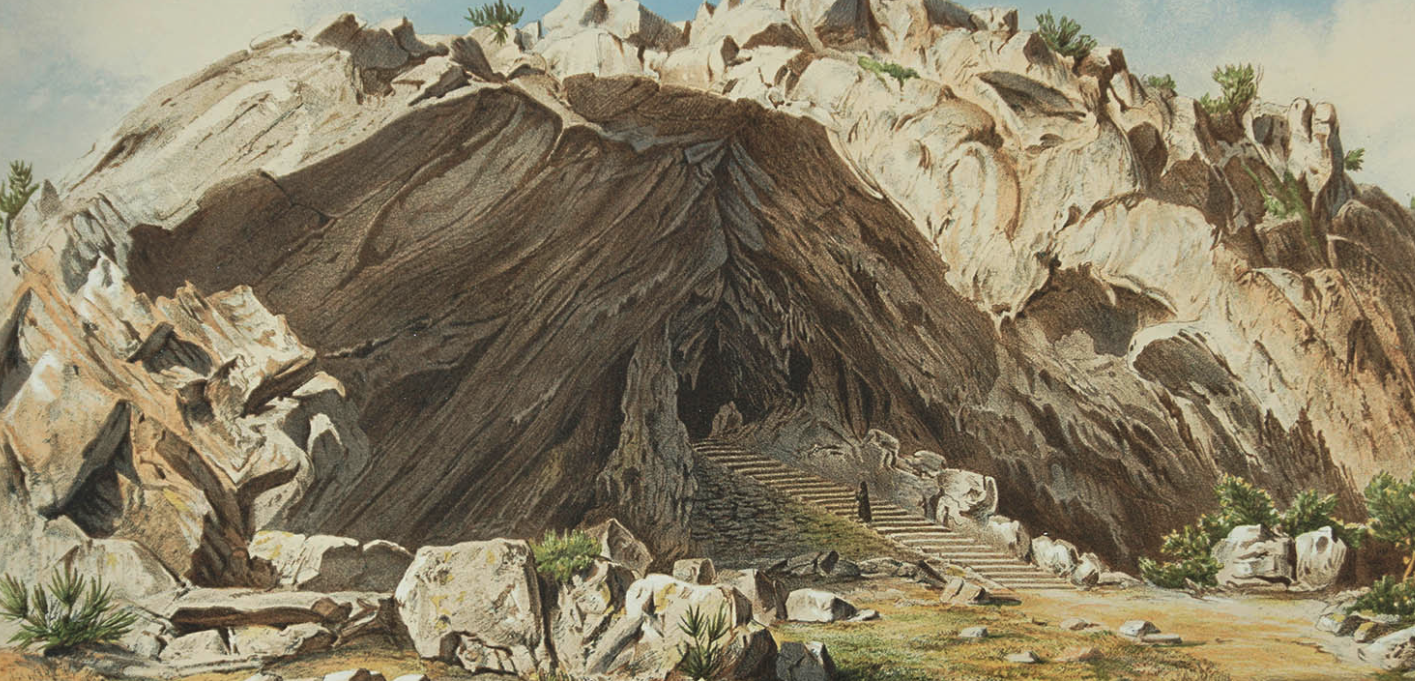
before the procession there rose the wild crag
of Cap Vermell, cloaked in oriental purple.
Like a titanic dwelling, on the flank of that cliff
opened a dreadful archway that, gaping, seemed
the maw of some monster that would swallow a laugh.
That weary company, climbing a harsh slope,
entered through the great mouth, at once losing there
the light of the sky and the varied din of sea and land.
Eternal, silent night… dark silence that terrifies…!
Dread, like a tombstone, covered the downcast youth
as of the light of day one last, straying ray,
bluish, faint, most sorrowful, melted into the shadow
like the last glimmer a dying man makes out…
* * *
Meanwhile, lit torches of red splendour
by degrees now uncovered that interior
of a temple, which showed, filled with wonders,
the very same divine art that filled the void with stars.
Columns of alabaster with prodigious moulding,
such as no chisel will ever carve upon the earth,
gathered, forming porticos and vast galleries,
and it seemed that there, like adorned pathways, they awaited
the triumphal passage of mythic legions…
Greater still, other columns, rising from the wide depths,
stood solitary at so supreme a height
that above, their lavish sculpture was lost from sight
where the light of torches and lamps could not reach.
Richest tabernacles and thrones with canopies
of filigree, tents of splendid drapery,
statues clothed in folding raiment,
tombs, altars, idols and imagined monsters;
all that immortal ravings might invent
of most sublime beauty and enchanting mystery,
beneath proud vaults that the power of no empire
could ever imitate, all forms a vision
that with sovereign force compels admiration.
There holds secret court the august majesty
of the Invisible, and it seems that, in fitting sign
of his power, he displays trophies upon those walls,
of enemies that were, of enemies yet to come.
So along the cornices there are seen in rows,
woven of alabaster, the magic banners
that seem to proclaim a hundred and a hundred victories.
* * *
In the middle of that cave there rose a great altar
without idol or other emblem, a mass of stalagmite
sacred to the Unknown God. That was the destination
toward which the long procession made its way.
Before the altar fell in mute adoration
the priests and wise-women. Then Nuredduna,
from a bunch of flowers she carried, gathered by moonlight,
made a crown and crowned the captive with it
as the chosen victim, as the law prescribes
of the hidden God.
A cup she then gave him to drink
of the powerful narcotic that brings sleep and belief
in consoling visions, calming suffering.
Melesigenes drank, as one who now consents to all,
surrendered to fatal misfortune, expecting nothing.
Then they chained him to the altar, in such a way
that he could not move, and, having secured him,
left him with the lyre hanging at his side.
While Nuredduna poured the libation,
the terrible procession formed anew,
and, intoning a chant, took its way
toward the open light and the endless horizon…
And there Melesigenes remained all alone now,
alone with the silence, the darkness and the agony,
alone, a span of life sadder than any death.
With every instant the voice of the loud chant grew darker,
with every instant those pine-torch lamps grew paler…
In fleeting bursts, now seen, now unseen,
the procession vanished through that sacred forest
of trunks of living stone… The shifting glow,
fleeing, gave the shadows a semblance of life,
and it shaped monsters that, in a boundless black flock,
seemed to flutter, flying, around the youth.
So the wonders of the place were for him
like an immense whirlwind of horror that engulfed him.
And when, fading into the distance, at last there dissolved
even that last trace of voices and of light,
Melesigenes felt the urge of extreme fury:
he leapt up, but the harsh chain that shackled his feet
stopped him, clanking.
Then with his full voice
he hurled at the mute shadows a cry, a horrible cry,
which was repeated by the echo in a mocking voice.
Then a desperate muteness sealed his mouth,
and all that could be heard through the depths of that abyss
was the eternal drop of water from the weeping drip,
which counts the passage of centuries and makes it more dreadful.
What furtive light was descending through the great chasm?
Just then Melesigenes was waking from his stupor,
when far off he seemed to see a little light
that little by little was coming, coming toward him.
He rubbed his weeping eyes, doubting whether what he saw
might still be a dream; and he believed it more a dream
the closer he watched the strange apparition.
It was the Prophetess, who with eyes of compassion
greeted him serenely, saying: “Son of the dawn,
you shall not die! Cast off the grief that weighs on you.
I will save your life, I will open the way for you…
If before my people I contrived to bring you here
and chain you to the altar of the Unknown God, it was
already with a hidden design of freeing you… Wait!”
So speaking, the young woman undid the great clasp
that joined the chains to the altar from beneath.
If the Greek understood nothing of that strange speech,
by the sweetest tone of voice and the manner accompanying it,
he could well enough recognize the unexpected fortune
by which a woman was drawing him from the arms of death.
“O you!” he exclaimed, “divine vision, if you are not delirium
with no other deceit, as cruel Fate ordains…
But no, you do not deceive me: your voice, like mead,
with its sweetness revives my downcast courage…
Might you perhaps be, O maiden of the woodland,
crowned Artemis who guides the hunters?
Does brother Apollo send you, whom singers invoke
and toward whom my song flew every day?
Let me worship your feet fragrant with ambrosia,
and save me, O divine one!”—
So spoke, now freed
of the fatal chain and prostrate on the ground,
the graceful Melesigenes.
Then Nuredduna
signed him to rise, took up at once in her hand
the shining torch and a dagger of smooth bone,
and with a resolute sign commanded him to follow her.
* * *
The maiden and the rhapsode went without a word
straight toward the exit, and scarcely looked
at the great magnificence of that august cavern.
She, with her poetic heart, savoured the taste
of the gentle words which, heard shortly before
and not understood, carried undefined sweetnesses
like the voices of a tune lost within the night…
He, only with keen haste to see himself already out
of that immense sepulchre, beat hard the wings
of his heart, and within the magic space of those halls,
before his astonished eyes, looked only
upon the mysterious maiden who led him to safety.
Coming out of the cavern, for a long time already they had been walking,
and not a single thread yet of the light of day
could be seen filtering among the columns.
Perhaps lost
was the path they took… Amid the lofty stillness
of the prodigious abyss, might they be straying,
and, seeking the door, be burying themselves within it
beyond remedy?
Such a terrible and anguished doubt
Melesigenes felt, and already his wary step
he was about to halt, when higher up, open,
he saw the great gateway, showing the uncertain light,
bluish and purplish, of a twilight sky.
He ran to the door, frantic, and gazed
toward the vast horizon, and there, breathing in all the air
his chest could hold, he came close
to letting out a song or a cry.
At that moment
the maiden imposed silence on him, and already, above
the open gateway, calm, she pointed out to him the waves
that there, at their feet, slept in calm…
At times
a gentle murmur rose from the shores,
or the plaint of a gull that to its corner of peace
came reflected.
The moment was propitious
to attempt the flight without showing any sign of it.
At the hour when at a distance everything is already lost to sight,
they could come out safely, the place being deserted.
Nor was discreet and opportune light lacking,
for in the east already the moon's rising could be seen announced.
Well indeed had the prophetess chosen her moment!
Crowned with stars, the pensive night
reigned, and seemed, covering the whole hemisphere,
to be brooding over the world a seed of love and mystery.
Oh! how, in that hour, those two lives
would have spoken together, had not
their different tongues forbidden it!
Then the maiden,
raising her hand, pointed to the evening star,
and the youth, raising his gaze toward the resplendent star,
then pointed gently toward the maiden.
Thus in silence, they went down to the nearby sea.
There, from a point that jutted into the sea,
the young woman again made a sign, and the Greek made out
the ship of his own people, which waited to gather in
the companions who had come ashore.
For the happier
good fortune of the rhapsode, Nuredduna then
showed him, just then fitted out by her,
a little boat made from the hollowed trunk of a hackberry tree,
fitted with oars of wild olive wood.
Before such kindness,
overcome, Melesigenes knelt down swiftly,
kissing just the fringe of her fallen veil.
At once she made him sit, and there, well prepared,
she offered him food: vegetables and roasted meat
and a golden honeycomb, and with milk milked that day,
to drink, a great cup filled with mead.
Melesigenes calmed his hunger and cruel thirst,
and while, as a token of gratitude, he was thinking
of leaving her his sweet lyre, he realized, surprised,
that in the anxious haste to escape death
he had not even thought to save his lyre,
and had left it hanging over the dreadful altar.
To go back and recover it was no longer possible for him,
and so from Nuredduna he took his leave, weeping
with gratitude.
But she, stifling the feeling
that struggled to burst from her heart, severe,
made the sign of departure, and meanwhile from the shore
untied his boat for him.
Then, standing atop a reef,
she wished to watch him flee… Then, wet
with hidden tears, was the edge of her veil…
And while the rhapsode drew away into the distance, there rose,
past its fullness, the moon from the eastern sea,
slow, huge, tinged with a bloody red,
showing within the silence of its nocturnal dawn
the aspect of a sinister and vengeful Medea.
……………….
The breath of one who recovers space, freedom,
the exertion of one who sees himself raised up from death,
Melesigenes felt as he rowed toward the ship
of his own people, and while still some way off he called for help
in a well-known voice, so as to be well received.
With eagerness everyone there received him, and to his health
making a friendly libation, after all had drunk,
gathering round him on the deck, they made him tell
everything that had happened to him in his long absence.
Then, with his words of magical colour,
he painted it all: the capture, the captivity,
the death of all his other companions amid the mystery
of the sacred wood, his own coming immolation
within the august cavern, like unto the abode
of Hades, king of shadows, and finally the unhoped-for
fortune of coming out through the unexplained work
of a Goddess or maiden of unknown name.
Such was their resolve: to depart with the greatest speed
and summon the forces of the conquering people
to wipe out the tribe that wrought such horror.
* * *
At the hour when the red moon rose from the sea,
Nuredduna too was climbing up from the waves,
when she heard a sudden noise, a growing noise.
She wished to slip away swiftly, but amid lights and people
she found herself trapped.
The one leading them there
was the very same man who, the evening before, had already assailed her
with malicious words upon the talaiot.
So then that grey-haired man said: “Who can
declare the oracle of the Gods on a sacred night
but the proud maiden who is inspired by them?
A God, as she said, commanded that the fair captive
be left alive as a victim in the cave…
Therefore the pure prophetess must show us
how that captive lies bound within the darkness,
unless he has already made himself invisible like that God…
Your people, O Nuredduna, want to see what is theirs,
want to search the cave!”—
Through the lofty gateway
meanwhile the prophetess had already climbed up,
and from that sublime mouth, over the sea
and the savage mob, her voice rang out:
“Open is the door of the den; you may enter it
without me, hearts of the genet, you who thirst for blood…
But the man who guides you seeks not the captive there:
he seeks Nuredduna, whom the bloodthirsty man hates.
So now hear my final words.
I have heard clear the voice of the Invisible,
I have been able to understand it within a beat of love;
and it says that victims of horror do not please him,
that blood vainly shed is abhorrent to him,
that in his will he is no tiger or vulture craving slaughter!
Now I see, now I see the dawn of that future age
in which, as the riddle says, the Virgin shall give birth.
When the Invisible shall show himself to man in speech,
new dew from heaven, pure tenderness shall rain down,
and to his fellow man each man shall know to say brother.
Hail, distant light, lost within the darkness,
that on the wings of my song show me a glimmer!
My life breathes out to you like a light perfume…
Away, horrible weapons and bloodthirsty fevers
of gods and sacrifices of bestial stench!
Away from this temple! Let not impure people here
stain wonders they cannot build…
If you so wish, go stain the rocks of the talaiot,
which ancient giants raised, after their own stature…
Here only the Invisible is God and priest!”—
So spoke the prophetess, and a thrown stone
whistled toward her head, while an angry voice
cried: “Did you hear her? She has blasphemed the Gods,
and whoever blasphemes the Gods rightly dies stoned.”
At once a shower of stones came bouncing
around Nuredduna, and some struck her,
while she ran, entering into the darkness
of the sacred cave.
From a secret dread,
those armed men dared not follow her.
Behind
the great gateway they heard how, with a fire-stone,
she was lighting a lamp, and through the immense cavern
they saw only a trace of light, ghostly.
* * *
Deeper, ever deeper through the solitary cavern
went the stoned maiden. The peace of the sanctuary,
with its cold kiss, calmed her brow.
But alas! She left a trail of blood everywhere she went,
now walking slowly. Her strength was failing her,
her feet already grew clumsy, her eyes could hardly see…
At last she could just plant her lamp upon the altar,
and sank down, spent, beneath that august stone.
There, half swooning, she felt faint, lost
murmurs vibrate in her ears; then the mute shadows
gave to her spirit something like a clear language,
and voices of the great silence seemed to sing thus:
«Rest among us, rest, human maiden,
away from the lives a storm sweeps off.
Within the pure depths that your great heart craves
we, alabaster maidens, wish to call you sister,
untouched women of water, we wish to weep with you!»
«O flower of this land, seized by mystery,
forget your woodlands where all leaves fall and fades,
forget your family of blood and captivity
within our efflorescence of everlasting realm,
within our tabernacle of supreme peace!»
«Here the work of centuries transfigures the rocks,
and without pain or hindrance calmly the hand
of nature continues polishing this abyss…
Ah! it is not so among men: well you know it, O untimely
bud of a race that does not even know you!»
«But in every thing the law must be kept.
Within the universe beats a powerful aspiration;
and so in lands and peoples, in peace or angry strife,
with tears or with slow dripping, formed little by little,
the boundless work grows, seeking perfection…»
«Fortunate you, maiden inspired by a hidden God:
leaping beyond your century, you are its sublime victim!
Take from the altar, for it is yours, take the abandoned lyre…
For one beat of the yearning with which your heart is dying
we would give the centuries of calm that we possess.»
«Fortunate you! Your life, brief as a lily or a rose,
reaches even unto the infinite through heart and thought.
Die now, for the Invisible sets his rich ring upon you.
You may sleep in his bridal bed, waiting, O bride!
while your star rises, keeping watch over the firmament…»
«Ah! sleep among us, rest, human maiden,
away from the lives the storm sweeps off.
Within the august depths that your great heart craves
you shall be sovereign of the alabaster maidens:
untouched women of water, we shall now weep for you!»
Like a broad torrent that advances murmuring,
if it meets a wall of rocks that defends against it,
it dashes against the rock, leaping with greater fury;
and if then it happens that a thundering cloud
hurls thick hail upon it, it grows more enraged
and with more terrible waves roaring hurls itself against it;
so did the mighty army of Boken-Rau
across the land of that tribe, which refused all peace.
Upon the cyclopean wall the whole tribe
had already entrenched itself, and from the defended height
made the slingers' stones rain down, whistling,
upon the surging waves of foreigners.
Moving in waves below came arms, standards,
horses, chariots and a great many war machines,
superb display of a great, feared power.
Like demigods there shone amid the multitude
warriors in gleaming armour, of varied hues,
and black could be seen, half-naked, the archers
of Nubia, who on their shoulders bore only a quiver
of poisoned arrows covered with dragon's hide.
Like a sinister flock that almost hid the sun,
the arrows flew.
The enormous catapult,
if it could not bring down the rocks of that wall,
wrought destruction enough within that dark enclosure.
But what caused there the most disastrous destruction
was the work, never before seen, of a giant crossbow
which, with tow and pitch, hurled its bolts,
terribly ablaze, upon the old trees
of the sacred forest.
Among those branches
sparking, the flying flames caught hold…
The fire spread, and throughout the sacred place
there rained down from the boughs the fatal rain of fire
upon that tribe, who watched in terror
as the protecting boughs of their forebears
thus fell against them.
The fire grew by the instant…
The oaks burned like giant torches.
And old men, children and women, not seeing where, ran
here and there, and, falling to the ground, writhed
within an immense brazier of ashes and embers,
or else died crushed beneath the rough treetops
that with dreadful crashing fell from on high.
At last the mother oak of the whole thicket,
the one at whose foot stood the bloody altar,
gave up its dead branches upon the dead people
and, symbol of the tribe, its ancient trunk fell.
This, from afar, watched, gazing from a rock
of the hill of caverns, the priests together,
who from there cried out to the Gods and made vows
to strengthen, at the last, the tribe that never yielded.
Then the august hierarch, seeing it lost,
tore frantically at the untouched majesty
of his hair and beard, honour of his sacred head.
“O sons!” he said, “now is the hour: the tribe of the Oak
does not live upon a land ruled by the foreigner!
Let us go to the caves… Within that holy horror
let us leave our bones snatched away from the invader!
“Let us go!” answered all the ministers around him.
And descending from that height, mute and grim,
they gathered dry branches and pinewood torches,
which they loaded in bundles upon the youngest among them.
Thus together they arrived at the great gateway
of the grand caves.
Just as they entered,
in half-voice they spoke the names, lost there,
of the land's heroes and of its vanquished Gods.
Then, by torchlight and in funeral order,
they made their way inside, to the heart of the sanctuary,
still carrying the bundles of wood.
On arriving
in the midst of the great cave and at the foot of the great altar,
there they unloaded the burning wood.
They made of it a pyre, and soon, dazzling,
from amid the smoky mist the flame burst forth.
The bonfire rose, rose like a whirlwind
of hell's serpents, joined in formidable struggle.
“Let the holocaust begin!” cried the implacable old man,
full of serene strength and despair…
And priests and wise-women, with mute submission,
circling the bonfire, joined their hands together:
seven times in silence, dancing, they circled it,
and at the seventh turn, letting out a mortal cry,
into the tremendous pyre they leapt as one.
Now the last, the hierarch, as he was about to throw himself in,
wished to look whether some rebel one might be escaping,
and, casting his gaze afar, saw by the light of the fire
his granddaughter upon the throne of the most august place…
It was she, Nuredduna, who sat there impassive,
motionless, beautiful, pale, as if she felt
the Invisible's most secret oracle grown faint within her.
Her head leaned back against the wall of the throne,
showing a wound, a small red spring
that dripped upon her brow a trail of fresh blood.
Her arms clasped, as in supreme rapture,
the rhapsode's lyre, in an embrace of death…
Seeing her thus, her grandfather stepped back at once,
and with his final word, saying: “Ah, Nuredduna!”
leapt into the blaze of that burning pit.
***
For a long time that pyre burned
silently, as a holocaust of the solitary temple,
and the smoke of that fire, filling the high sanctuary,
darkened its alabaster vaults forever.
Thus, clothed in mourning, do you stand, Caves of Artà!
Thus within your entrails you keep, golden Island,
the eternal Greek lyre, envied by the wise,
gift of the ancient monarch of ideal singers
to your inspired daughter, worthy of his love.
But, alas! your august daughter, who bears the great lyre,
within its poetic depths remains motionless, dead.